Feasts in History

          Although some people disparage Thanksgiving as a gluttonous and gormandizing occasion, it seems almost frugal in light of historical feasts. The Romans, for instance, especially in the latter days of the empire, were infamous for their lavish spreads. At one ceremonial occasion, which Julius Caesar attended, the first course consisted of sea urchins, unlimited raw oysters, scallops, cockles, thrushes on asparagus, fattened fowls, and corn fish (both black and white). Then came cockles, mussels, sea nettles, figpeckers, haunches of venison and boar, fattened fowls cooked in pastry, more figpeckers, murex, and purple fish. After that came the main dishes: sow's udders, ducks, boiled teal, hares, roasted fowls, creamed wheat, and rolls. The emperor Elagabalus served his guests sausages, made from mollusks, prawns, oysters, squid, and crab, as well as camels' feet, the combs from live chicken, tongues of peacocks and nightingales, mullets' livers, the brains of flamingos and thrushes, and the heads of parrots, pheasants, and peacocks. Our dinner of turkey, dressing, potatoes, cranberry sauce, and pie seems paltry and mundane in comparison.
         We usually go to some trouble to set a grand table—linen tablecloth and napkins, napkin rings, the best silverware and serving dishes, the good china, crystal wine glasses. But during late Renaissance in Europe, tables were laid with several layers of tablecloths, each to be lifted in turn as new courses were brought in. Napkins were folded in complex shapes, such as flames, birds, columns, arches, trophies. At a banquet in honor of Giuliano and Lorenzo de Medici, each napkin enclosed a little bird, which flew way when the guest opened the folds. At one nuptials banquet in Brussels, the napkins were folded by famed napkin-folder Giovanni Milanese, who pleated the napkins to represent two castles compete with artillery, infantry and artificial fire in recognition of the royal groom's military career. The best sculptors were commissioned to make salt cellars and elaborate sculptural concoctions of sugar, such as those designed by Dorat for a banquet in Paris, depicting—in sugar, remember—the history of the goddess Minerva. At court, the most coveted jobs were those of the carver and of him who unfolded the king's napkin and laid it in his lap.
          We might decorate the Thanksgiving table with autumn leaves and tiny pumpkins, but entertainment is usually simply conversation—oh, and football on TV, of course. Renaissance banquets, on the other hand, became theatrical events in themselves, involving masques, processions, and allegories. At the Brussels banquet I just mentioned a masque was performed by "eight aristocratic children escorted by musicians and torchbearers" that ended with the presentation of posies of artificial flowers. Then the tables were cleared for the ball.
          Such elaborate dinners are but pictures in history now not even mimicked by royalty or heads of state, and we in our homes share far simpler feasts. The emphasis of our harvest celebration banquet is not on theater or decoration but on the food. To my way of thinking, that's where it should be.

Next week: "Emma Lou's Fried Apple Pies"

The End of the Story about Peppers

         For years I had to avoid peppers because of my allergy. I had to ask at every restaurant the ingredients of every food I might order. People who ate out with me got used to the spiel. For Christmas one year my sister gave me a script to hand to my waitperson: "I have an allergy to peppers—green peppers, bell peppers, hot peppers, pepper flakes, pepper sauce, cayenne, Tabasco, paprika—all peppers. But not black pepper. Black pepper isn't a real pepper. I can't eat food that has been cooked on a grill that previously had peppers on it. I can't eat off a plate that has peppers painted on it. If my waitperson is named Pepper I'll have to have a different one. Thank you for making my dining experience a pleasant one." Only the parts about the plate and the name are an exaggeration Everything else was a part of my spiel.
          Sometime waiters were careless. In spite of my having explained the peppers allergy to my waitperson at breakfast in a restaurant on the northern Oregon Coast, one bite of my potatoes alerted me that their reddish cast was paprika. I ate no more, but one bite was enough. Walking down the beach after breakfast, I suddenly felt the swords-in-the-stomach precursor to the bombs in the bowels. I turned back at once, walked fast, walked even faster, realized I wasn't going to make it, looked for something to shelter me on the long wide stretches of sand, made my way to a driftwood log, crouched behind it, and put on my ostrich mentality because what else could I do?
          Only once did a waiter berate me for being so hard to please. I never ate in that restaurant again. Most experiences were more pleasant and sometimes charming. At an Indian restaurant in Edinburgh, Scotland, I looked at the menu in dismay. Was there nothing I could eat? When I told the waiter about my allergy, he corroborated that there was nothing on the menu I could eat. "The chef will make you something special," he said. So the chef did, and it was divine. At another restaurant in Tacoma, Washington, the waitress told me that next time I should let them know a day ahead that I was coming, and they would create something for me. At a small restaurant in Greece, I was invited to go right into the kitchen to make sure the cook, who spoke no English, understood about the peppers problem.
          Yet inevitably, at some point, some kind of pepper would sneak into something I ate, and I would suffer the usual bout of sickness, the double-me-over swords in the stomach and the unending trips to the bathroom.
          One day, on my way to Eugene, Oregon, I bought a sandwich at a deli to eat on the road. I checked ingredients before I bought it, of course, but either "pepperoni" wasn't listed or I misread the placard, because when I had eaten about half the sandwich, I thought in alarm, "That tasted like pepperoni." So I stopped and opened the sandwich, and, yes, it was pepperoni, or what was left of it. Oh, god, I thought. Now I am going to be sick, and I hate being sick from peppers. Resignedly I folded up the rest of the sandwich, drove on to Eugene, and stoically faced an assured sleepless night.
          To my surprise I woke up the next morning, and—I hadn't been sick! That was interesting. So I ate the rest of the sandwich. I didn't get sick! It seemed miraculous. Could I eat peppers again? Cautiously, meal by meal, pepper by pepper, I experimented. Green peppers in a salad. Salsa with chips. I ate sausages again. I made the beautiful black bean and red pepper salad I had once enjoyed so much. I returned red
pepper flakes to my baked shrimp. Whatever peppers I had inadvertently eaten before I ate the sandwich with pepperoni were the last peppers to make me sick. I wondered with chagrin how long I had been able to eat peppers without knowing it. How many times had I unnecessarily asked whether there were peppers in a food I wanted to eat? How many times had I turned away from a Thai or Mexican restaurant when I didn't need to? How many times had I passed up scrumptious looking dishes at a potluck dinner because I didn't know what was in them?
          Such regrets are minor. Delight is foremost. I had discovered I could eat peppers only a month before a trip to Sicily. It was pure pleasure to be able to eat freely. As suddenly and mysteriously as it had appeared fourteen years ago, my peppers allergy had now disappeared. My culinary horizons have expanded again. I am free of the peppers allergy.

Next week: "Feasts in History"
Recipes from this post:
     Black bean and red pepper salad
     Baked shrimp, with pepper flakes


BLACK BEAN AND RED PEPPER SALAD
serves 8

Dressing
Ingredients:
1/2 cup water
16 dates (about 4 ounces)
2-3 limes
6 tablespoons olive oil
2 tablespoons dried oregano
4 teaspoons honey
4 teaspoons ground cumin
4 teaspoons ground coriander


Preparation
Boil dates in water for 2 minutes. Remove from heat, cover, and let stand 1 hour to soften. Squeeze the limes to yield 1/2 cup juice.
To make
Put the date mixture in a blender with the rest of the ingredients. Purée. Season to taste with salt and pepper.

Salad
Ingredients
4 15-ounce cans black beans
1/2 cup chopped red bell pepper
1/2 cup chopped yellow bell pepper
1/2 cup chopped green bell pepper
1/2 cup chopped red onion
1/2 cup chopped fresh parsley
Preparation
Drain and rinse the beans. Chop all the peppers, red onion, and parsley.
To make
Combine beans, bell peppers, onion, and parsley in a bowl. Toss with enough dressing to coat. Season with salt and pepper. Beautiful!


BAKED SHRIMP, WITH PEPPER FLAKES
serves 3

Ingredients

1 pound large shrimp
1 tablespoon extra-virgin olive oil
2 tablespoons white wine
4 large garlic cloves
2 tablespoons capers
1/2 cup Kalamata olives
2 medium tomatoes
1/4 cup chopped fresh basil
2 tablespoons chopped parsley
1 1/2 cups (6 ounces) feta cheese
1/4 teaspoon dried red pepper flakes (or more)
1 lemon
Preparation
Peel and devein shrimp. Peel and mince garlic. Drain capers. Pit and slice the olives. Peel and seed the tomatoes and dice into 1/2-inch pieces. Chop the basil and parsley. Crumble the cheese. Zest the lemon. Preheat oven to 375º.
To make
Combine all ingredients in a large bowl, then transfer to a 9 x 12-inch baking dish, spreading evenly. Bake until the shrimp turns pink, 15-25 minutes, depending on the size of the shrimp. Serve warm or at room temperature.

Confessions of a Picky Eater

          I hate picky eaters. When I offer someone my chocolate strawberry bavarian only to hear, "I appreciate the effort, but I can't eat chocolate and I don't like strawberries," or when a friend comes
Feat cheese tart
to lunch for which I've made my very best feta cheese tart, only to have him tell me he doesn't like mushrooms and isn't a big fan of feta, either—well, look, it's not like I'm giving them tofu and dulse. It's no wonder I'm contemptuous of picky eaters.
          Children are the worst. I didn't expect my friend's adolescent son to eat my corn and cheddar cheese soup, but I figured I couldn't lose with a carrot cake, especially my sister's fabulous version. I was wrong. Kyle turned up his nose at it—that much a picky eater. I was not a picky eater as a kid. I ate heartily and was easy to please, and, later, when I traveled, I ate all the local dishes—blood sausage in France, kefir in Russia, boiled pudding in England. One of the best feasts of my life was a vast array of burritos, tamales, enchiladas, chili rellenos, salsas, and two dozen other dishes I couldn't name spread down a long outdoor table at a private hacienda in Mexico. No picky eater I!
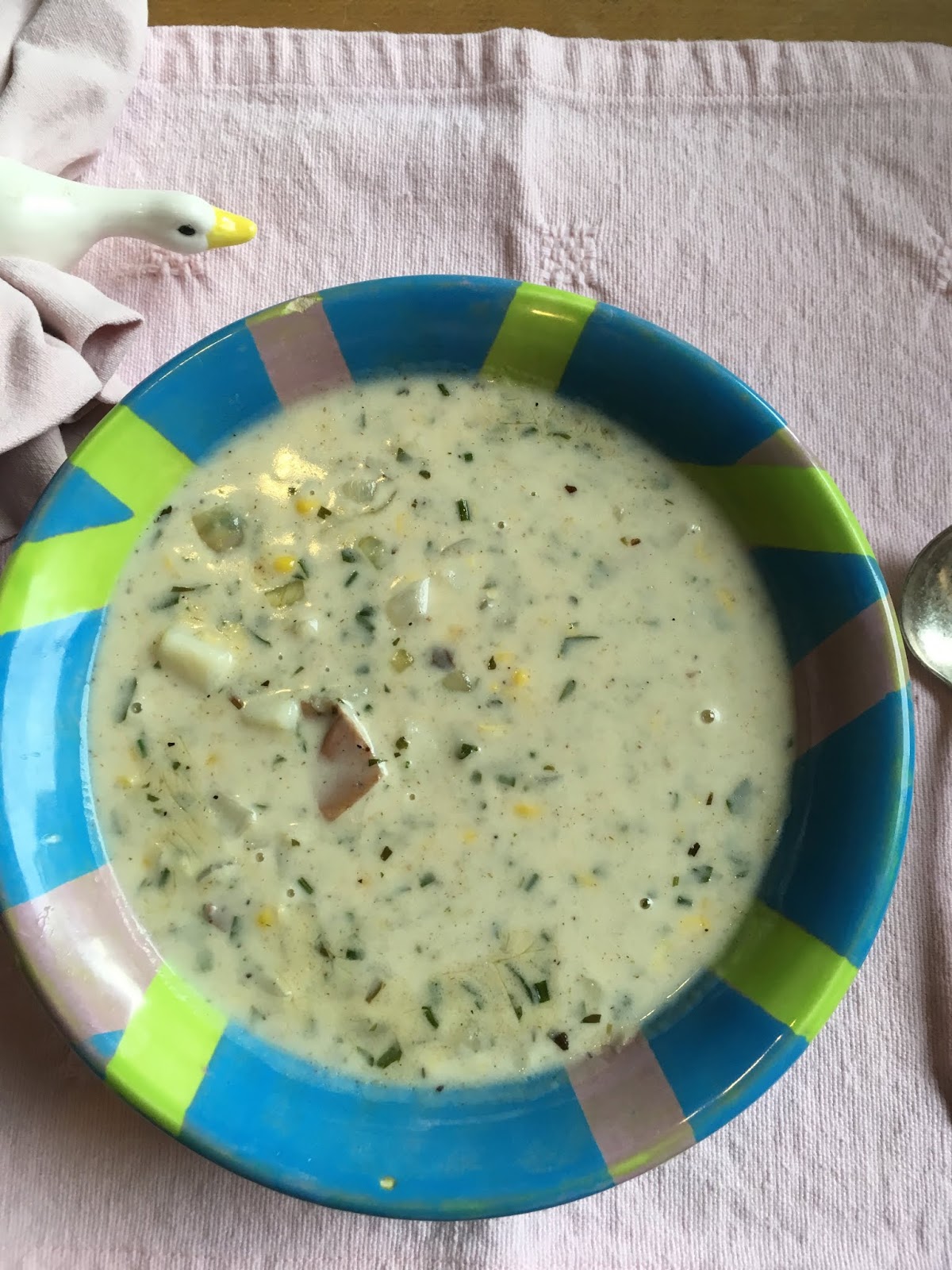
Corn and cheddar cheese soup
          Until now. To my rue and my shame, I could now be called a picky eater
          Actually, I've always disliked coconut, but one dislike of an infrequently used ingredient can be forgiven When I became vegetarian, I never expected any cook to cater to my diet. At any meal, I simply ate everything except the meat. Well, unless it had wild mushrooms in it. After becoming nearly deathly ill from the "safe" shaggy mane mushroom, I swore off all wild mushrooms.
          So—no meat, no coconut, no wild mushrooms. And then one night a few years ago I got horribly ill on cabañereo peppers, so I thought, okay, no cabañeros, either. Not too long after that I was driving home after a fabulous dinner at the Jacksonville Inn when severe stomach cramps had me biting my knuckles and screaming in pain, and I would have been doubled over, too, except the steering wheel kept me upright. By the time I was driving through the dark and empty forest, I was suffering from such severe and sudden diarrhea I was glad the forest was both dark and empty.
          The common ingredient was red pepper flakes, so now I thought I had an allergy to hot peppers, but soon after that incident I met a woman who mentioned she had an allergy to all peppers (the capsicum family). When I asked her what happened when she ate them and she said, "Swords in the stomach" (followed, in my case, by bombs in the bowels), I knew I, too, was allergic to capsicum.
         Now I scrutinize all food labels and inquire about ingredients of restaurant fare. Eating out has become difficult. I might as well not even step foot inside a Mexican or Thai restaurant, and because the biggest fad in contemporary cuisine is hot peppers, a typical conversation with a waiter goes like this:
          "I think I'll have the eggplant burger—if there are no peppers in it."
          "Oh, the peppers are blended into the sauce; you'll never notice."
          "No, no. this is an allergy—and you don't want me getting sick here."
          "What about the pasta salad, then?"
          "No, it has chicken in it, and I don't eat meat. What's in your Chinese stir-fry?"
          "Cashews, tofu, coconut …"
          "No, thank you. Does the garden burger have any peppers in it?"
          "I'll check….The cook says it comes in a package and we can't say for sure."
          "Can't do it. Isn't there anything here I can eat?"
          "I'll tell you what. I'll fix you an avocado sandwich special." And then—this really happened—he came back and said, "I'm so sorry. We're out of avocados."
          Contempt returns to haunt me. I would like to apologize now to Kyle and Lee and Tom and Sylvia and anyone else who is a picky eater. I apologize to all of you who won't eat onions or can't eat wheat or hate strawberries. I understand, now. I am one of you.

Next week: "The End of the Story about Peppers"
Recipes from this post
     Feta cheese tart
     Chocolate strawberry bavarian
     Corn and cheddar cheese soup
     Celebration carrot cake

FETA CHEESE TART

serves 6

The crust
Ingredients
1/3 cup butter
1 cup whole wheat pastry flour
(1/4 teaspoon salt if you're using unsalted butter)
3 tablespoons (or more) cold buttermilk
To make
Cut the butter into the flour with a pastry cutter or two knives (or whatever electrical implement is suitable). When the mixture resembles cornmeal, add enough buttermilk that the dough comes together into a ball. Wrap it in plastic wrap and let it chill on the back porch or in a refrigerator.

The tart
Ingredients
Pastry for 10-inch tart pan
1 egg, beaten with 1 tablespoon water
Preparation
Remove the dough from its chilling spot and let it sit for 10 minutes. Lightly flour a working surface and a rolling pin. Preheat the oven to 300º.
To make
Roll the crust out to a 12-inch disk. Put the pie crust into a tart pan and prick the bottom and sides of the crust. Brush it with the egg wash. Bake the crust at 300º for 20 minutes, until it is golden brown. Cool.

The filling
Ingredients
1 pound fresh mushrooms
4 tablespoons butter, divided
3 medium tomatoes
1/2 pound fresh spinach
2 ounces feta cheese
1 tablespoon dried whole oregano
2-3 eggs, to make 1/2 cup
1 1/2 cups heavy cream
1/2 teaspoon salt
1 teaspoon pepper
Preparation
Halve the mushrooms (or quarter them if they're big). Cut the tomatoes into 8 wedges each. Wash the spinach. Crumble the feta cheese. Whisk the eggs and cream together. Preheat the oven to 325º.
To make
Sauté the mushrooms in 2 tablespoons butter until they are brown, about 8-10 minutes. Drain them. Set them aside. Add the remaining 2 tablespoons butter to the skillet and sauté the tomatoes until they render juice and no longer look raw. Drain them well and set aside. Wilt the spinach in a small saucepan over medium heat. (Do not add any liquid.) Into the pastry shell put half the crumbled feta cheese. Top that with the mushrooms, then the tomatoes, then the spinach, then the oregano, then the remaining feta cheese. Add salt and pepper to the whisked-together eggs and cream, whisking afresh, and pour this mixture over the filling, whisking while pouring. Bake at 325º for 1 1/2 hours, rotating the pan after 45 minutes to allow the tart to brown more evenly. Cool 30 minutes before serving.


CHOCOLATE STRAWBERRY BAVARIAN

Yield: 12 servings

Ingredients
2 envelopes unflavored gelatin
1/3 cup water
1 2/3 cups milk
2 eggs
3 cups ricotta cheese
1/2 cup plus 2 tablespoons sugar
1/3 cup unsweetened cocoa
1 1/2 teaspoons vanilla
Preparation
Sprinkle gelatin over water in medium saucepan. Let stand 5 minutes. Separate egg. Divide sugar into two portions: 1/2 cup and 2 tablespoons. Butter a 9-inch springform pan.
To make
Combine milk and egg yolks till well blended. Add to gelatin mixture. Cook over low heat, stirring constantly, till gelatin dissolves. Mix cheese, 2 cups sugar, cocoa, vanilla, and one-third gelatin mixture. Blend well. Combine remaining gelatin mixture and cheese mixture in a large bowl. Chill to consistency of unbeaten egg white.
Beat egg whites 1-2 minutes. Gradually add 2 tablespoons sugar, beating till stiff peaks form.
Gently fold egg whites into chilled chocolate mixture. Pour into prepared pan. Chill 3 hours.
To finish
Ingredients
Chilled bavarian
1 (1-ounce) square unsweetened chocolate
2 teaspoons butter
1 1/2 cups small strawberries
 Fresh mint (optional)
Preparation
Remove cake from pan and place om serving platter. Cut strawberries in half if necessary. Combine chocolate and butter in small saucepan. Cook over low heat until melted.
To serve
Place strawberries decoratively on cake. Drizzle chocolate mixture over in diamond patterns. Decorate with a sprig of mint if desired.


CORN AND CHEDDAR CHEESE SOUP

serves 4-6

Ingredients
1 large potato
2 cups boiling salted water
1 bay leaf
1/4 teaspoon dried sage
1/2 teaspoon cumin seeds
3 tablespoons butter
1 onion
3 tablespoons flour
1 1/4 cup heavy cream (or 3/4 cup non-instant milk powder plus 1 1/4 cups water)
kernels of 2 ears of corn
chives and parsley
1/4 teaspoon nutmeg
salt and pepper
1 1/2 cups grated sharp cheddar cheese (4 ounces)
4-5 tablespoons dry white wine

Preparation
Peel and dice the potato. Chop the onion and the parsley and chives. Cut the corn kernels off the cob. If you use powdered milk, mix it with water to yield 1 1/4 cups double thick milk. Grate the cheese.
To make
Boil the diced potato in the salted water with bay leaf, sage, and cumin seeds until potato pieces are just barely tender (15-20 minutes). Melt the butter in a saucepan and sauté the chopped onion until translucent. Add the flour to the butter and onions to make a roux and cook for 1 minute to get rid of the raw taste. Remove from heat and gradually add the cream (or double milk, for less fat without sacrificing too much of the richness), stirring all the while with a whisk. When it is smooth, pour this sauce into the potatoes and their water, adding the corn kernels, then the parsley, chives, and other seasonings. Simmer the soup gently for about 10 minutes. Then stir in the grated cheese and the wine and stir until cheese is completely melted. Correct the seasonings and serve.


CELEBRATION CARROT CAKE
Topped with sunflower seeds
services 15-20

The cake
Ingredients
4 eggs
3/4 cup honey
1 1/2 cups oil
2 cups whole wheat flour
1/2 teaspoon salt
2 teaspoons baking soda
2 teaspoons cinnamon
4 cups grated carrots
Preparation
Grate the carrots. Grese a 9x13x2-inch pan. Preheat the oven to 325º.
To make
Beat the eggs. Add honey and oil and beat again. Add the dry ingredients and beat till blended. Do not overbeat. Fold in the carrots. Spoon the batter into the greased pan and bake at 325º for 40 minutes. Turn off the oven, but leave the cake in it until it is nearly cool.

The icing
Ingredients
7 tablespoons butter
8 ounces cream cheese
Honey
Chopped nuts
Preparation
Be sure the butter and cream cheese are soft. Chop the nuts.
To make
Beat the butter and cream cheese till fluffy. Slowly beat the honey into the butter and cream cheese till the mixture is sweetened to your liking. Add as many nuts as you like.
To assemble
Frost the cooled cake with the cream cheese icing.
     

A Boiled Egg in the Wilderness

          One day last summer on a hike in the Red Buttes Wilderness Area, I had a hard-boiled egg for lunch. Maybe the spectacular setting, fresh mountain air, and good exercise influenced my taste perceptions, but I couldn't stop exclaiming over how good that egg was. Finally one of my hiking partners asked if that egg was really any different from any other.
          Well, yes, as a matter of fact, it was. I buy my eggs, in season, from Bill and Mary, down the road. They have a mingled flock of several breeds, about 60 chickens in a large fenced-in yard to keep dogs and foxes at bay. The roosters strut about the yard with their sleek iridescent black tails gracefully arched and their necks protectively stretched as chickens cluck and peck around them. These days the chickens give about three dozen eggs a day. Pretty soon that'll be up to five dozen. Bill complains when customers buy more than a dozen eggs at once, leaving none for the next customer.
          "It seems they would want to buy another dozen later, anyway," I said, "to have fresher eggs." Bill agreed but said that even two weeks later, these eggs are more fresh than anything you could buy in a supermarket. 
          Their shells range from creamy white to deep beige to pale green. When I break an egg into a dish, the dark yellow yolk domes high in the translucent white. My scrambled eggs are a deep yellow. Over-easy eggs keep a thick yolk that runs creamy over toast. Bill told me about one customer who uses the eggs to make pasta. "The pasta is so yellow people ask if she put food coloring in it," he told me.
          In the eighteenth century a chef was not considered worth his salt unless he could cook eggs a hundred ways. Could I do that? I came up with about thirty ways—various ways to fry, boil, scramble, poach, or coddle eggs; recipes for soufflés, quiches, timbales, meringues, and custards. At that point, out of ideas, I consulted the cookbooks.
          In The Joy of Cooking  I found that if I whipped egg whites and baked them with the yolks inserted in indentations, I would have eggs in a nest. My Horizon Cookbook and Illustrated History of Eating and Drinking through the Ages gives a recipe for marbleized tea eggs (boil the eggs, crack their shells, reboil the eggs in their cracked shells in tea) and one for Scotch woodcock, a rich concoction of butter, cream and egg yolks that is, the editors claim, "no less delectable for want of a genuine woodcock." The same cookbook has a recipe for the beautiful-sounding oeufs a la neige: snow-eggs.
          How many ways is that? Maybe if I count asparagus quiche different from broccoli quiche, ginger soufflé from cheese soufflé, and so forth, and if I add things like chess pie and angel food cake, which aren't included among egg recipes but might count because they are mostly eggs, maybe I could think of a hundred ways to cook an egg. But however I cooked it, I would know that, if I used eggs from the farm, all those dishes would have all diners exclaiming, "How good that was!"

Next week: "Confessions of a Picky Eater"
Recipes from this post: 
     Eggs in a nest
     Oeufs a la neige
     

EGGS IN A NEST
(from Joy of Cooking, by Irma S. Rombauer and Marion Rombauer Becker)
serves 1-2

Ingredients
2 eggs
Salt and pepper
chives (optional)
Preparation
Preheat oven to 350º. Separate the eggs. Chop the chives. Butter a small ovenproof dish. 
To make
Beat the egg whites till very stiff, then transfer them to the buttered dish. In the center of this mound make two indentations. Slip the egg yolks into these cavities. Bake until the eggs are set, about 10 minutes. Season with salt and pepper and sprinkle with chopped chives to enhance the presentation.


OEUFS A LA NEIGE
(I haven't actually made this recipe, but it sounds so good I thought I would pass it on to you, from the Horizon Cookbook and Illustrated History of Eating and Drinking through the Ages.)
serves 5-6

Ingredients
5 eggs
1/4 teaspoon cream of tartar
1/4 teaspoon salt
1 1/4 teaspoons sugar
2 cups milk
1 2-inch piece vanilla bean (or 2 teaspoons vanilla extract)
2 tablespoons cognac or rum (optional)
Preparation
Separate the eggs. Scald the milk in a deep, wide saucepan. Prepare a double boiler with simmering water.
To make
Beat egg whites with cream of tartar and salt to the point of soft peaks. Beat in 3/4 of a cup of sugar, 2 tablespoons at a time, to make a very thick and stiff meringue. In the scalded milk add 3 tablespoons of sugar and the vanilla bean. Shape the meringues with a large tablespoon and poach in the milk over a very low heat for about 3 minutes. Use two forks to turn them gently and continue poaching on that side. Remove with a slotted spoon to a serving dish.
       Beat the egg yolks until very thick and pour into the hot milk in a thin stream, beating constantly. Scrape vanilla seeds into the custard, or, if you're using the extract, add it now.  Cook the custard in the top of a double boiler over 1 inch of barely simmering water, stirring with your favorite wooden spoon until the mixtures coats the spoon. 
          Cool. Add cognac and pour around the meringues. Caramelize the remaining sugar and dribble it over the meringues.

Falling from Grace, Part II

          I was proud of having followed the doctor's orders by increasing my protein intake, but at my next appointment the doctor was not impressed. "You need to eat meat," he said, "red meat."
          I balked, upset, and asked, "If I can get enough protein otherwise, why should I eat meat?"
          He said, "Red meat is the original diet of our species, It contains important hormones. You don't want to have the metabolism of a chicken or a fish, do you?'
         "I don't particularly want the metabolism of a raging bull, either," I returned, and I started to point out that his first reason fell into the logical fallacy of Appeal to Tradition (Fault #3), but at $150 an hour I decided not to argue and asked instead for the alternatives.
         "You can take supplements consisting of the spleen and kidneys and other offal of the red meat animals," he said.
          I said, "Never mind." I wasn't liking this, but my $400 already invested kept me from walking away.
          Then the doctor led me to his elecrtric-impulse machine to find out why I didn't want to eat meat
          "Does Diana not want to eat meat because she is sympathetic to animals?" he asked and touched my finger with the electric wand. The machine drew a steep, sharply peaked line on its screen and whined a high note, meaning "No."
          "Is it because she thinks meat is not healthy for her?"
          "No."
          "Is it because she doesn't know where to buy meat or how to cook it?"
          "No."
          "Is it because she feels superior by not eating meat."
          "Yes!"
          I flung my hand away, crying, "I don't believe it!" To think that I thought I was superior to someone else just because I didn't eat meat was preposterous. The patient look on the doctor's face ("I've dealt with your type before") also upset me, but I was wasting time (money) by resisting, so I composed myself and finished the exam. Then the doctor told me where to buy good, natural meat, and the appointment was over
          I went straight to the recommended meat market, but I hardly knew what to do there. "I've been a vegetarian for thirty years," I told the saleswoman, "and now the doctor wants me to eat red meat." She nodded compassionately. I think she had met patients of this doctor before.
          "What about lamb?" I asked, thinking vaguely that lambs were little and would be an easy place to begin. But she said a lot of people didn't like lamb, bringing up the idea that I might not like the taste of meat. I said, "Well, what about lean beef?"
          At that the customer behind me spoke up "Don't overcook it," he advised. "Overcooking meat destroys the enzymes." Then he added that he ate his raw.
          I recoiled. The saleswoman diverted me by saying if I wanted lean meat, I should try buffalo, so I bought a pound of frozen ground buffalo meat and went home,
where I put on a pot of brown rice and steamed a whole bundle of kale, then ate everything mixed together with brewer's yeast, olive oil, and balsamic vinegar, topped with a sprinkling of walnuts. It was a delicious dinner.
          The next day I found a recipe for sausage shepherd's pie. I thought I could use it by substituting buffalo for the sausage. At 5:00 I gathered my ingredients. I put a skillet on the fire. I dumped the meat into the skillet. It sizzled. It browned. It smelled. It tainted my pan!
         "Okay, Diana," I told myself. "People all over the world do this. So can you."
          I made my buffalo shepherd's pie and put it in the oven. Forty-five minutes later I took it out. I looked at it. I divided it into four parts and put one on my plate. I looked at my dinner. I picked up my fork. I ate meat.
         Nothing happened. Angry gods didn't stomp on the roof. Doe-Eyed buffalo babies didn't wail and cry. My stomach didn't rebel, and my bowels didn't complain. The only difference has been my shame in admitting to my vegetarian friends wha I have done. Here was the vindication of the doctor's machine. I admit it now. I am one of those fallen from grace. I am cast from the garden. I belong with the less enlightened. I eat meat.


Next week: "A Boiled Egg in the Wilderness and Other Ways to Cook an Egg"
Recipes from this post:
     Steamed greens and rice
     Buffalo shepherd's pie


STEAMED GREENS AND RICE
serves 1

Ingredients

1 bundle of kale, chard, collards, or other greens
Mushrooms
1 cup brown rice, cooked
Olive oil
Balsamic vinegar
Brewer's yeast (optional)
Walnuts
Salt and pepper
Preparation
Strip the leaves off the stems of the kale. Slice the mushrooms.
To make
Steam the greens. Steam them well, though don't let them get mushy. Meanwhile, sauté the mushrooms in the olive oil. When the greens are cooked to your satisfaction and the mushrooms browned, mix them together. Mound the rice in the middle of a large dinner plate. Put the greens mixture on top of the rice. Give yourself a generous helping of brewer's yeast (maybe 2 heaping tablespoons) . Pour some olive oil over that and then some vinegar, to taste. Crush some walnuts in your fingers as you sprinkle them on top of everything. Use salt and pepper as you like.


BUFFALO SHEPHERD'S PIE
serves 4

Ingredients

1 1/2 pounds sweet potatoes
1 pound butternut squash
1 medium russet potato
2 tablespoons (1/4 stick) butter
1 1/2 pounds ground buffalo
1 tablespoon olive oil
2 cups chopped onions
1 tablespoon minced garlic
3/4 cup frozen peas
3/4 cup frozen corn kernels
2/3 cup nonfat powdered milk
1 large egg, lightly beaten
1 1/2 teaspoons curry powder
1/2 teaspoon ground coriander
Preparation
Thaw the meat, if it is frozen. Peel the sweet and russet potatoes, and peel and seed the squash. Cut all these vegetables into 2-inch pieces. Chop the onions. Mince the garlic. Grease an 8-inch square pan. Preheat the oven to 350º.

To make
Boil the sweet potatoes, squash, and russet potatoes together in a large pot of water until the vegetables are tender, about 25 minutes. Drain, mash, and stir the potatoes over medium heat for about 5 minutes to evaporate the excess moisture. Add butter. Add salt and pepper to taste. Cook the buffalo meat in a skillet over medium heat, just as though it were sausage, until it is brown. Because buffalo isn't sausage, though, it will render no fat for sautéing the onions and garlic, so lift the cooked meat from the skillet and add 1 tablespoon olive oil, then the onions and garlic. When the onions are translucent, add the sauté to the buffalo meat. Let everything cool a bit; then add the rest of the ingredients (not the potato mixture) and mix well. Spoon the buffalo mixture into the prepared pan. Spread the potato mixture over the top. Bake 45 minutes to 1 hour so that everything heats thoroughly and potatoes have begun to brown. Let the shepherd's pie sit for five minutes before serving. Eat if you dare.

Falling from Grace, Part I

          My New Year's resolution was to get rid of my migraine headaches—whatever it took, whatever it cost. So when I heard of a naturopathic doctor with a reputation for healing migraines, I called for an appointment. When I found out much he charged, I almost reneged, but a resolution is a resolution. I stuck to mine.
          I was apprehensive, though. I knew that the doctor had a poor opinion of wheat, and I didn't want to stop eating wheat. I also had a nagging fear he would tell me to stop eating dairy products, and I do love my yogurt. But "no matter what it takes," I reminded myself, as I waited in the reception room for my appointment.
          This two-hour conference covered everything from my thirty years as a vegetarian to my two-year bout of schizophrenia, about which the doctor said, "St. Francis talked to the animals, too." (Well, yeah, but they talked back to me, I pointed out.) Finally, he asked if I had any belief systems that would preclude any suggestions he might take. I follow no religious doctrine, so I said no. Then he did an examination which involved electrical impulses that measured my body's response to certain questions, after which he told me that low progesterone levels resulted in headaches and that protein intake affects progesterone levels.
          "You're protein deficient," he said. "Eat meat."
          Eat meat!! "Oh, I don't know," I said, suddenly confronted with belief systems.
          "Do you have the 'doe-eyed 'syndrome?" he asked dryly, meaning that the bigger the brown eyes of the animal, the more staunch the vegetarian. No, I didn't think so, I said. He asked if I would eat fish, and I said, yes, I thought I could (trying not to think of those big brown salmon eyes), and then he mentioned organic chicken, organic beef, bison, and emu. Eat bison and emu?!
          He said I had an allergy to soy but that rice protein powder, yogurt, cheese, and eggs would be good for me. I thought how pleased the people on the egg farm where I buy eggs would be to hear about the doctor's advice,
          But why was I so resistant to the idea of eating meat? It wasn't just thirty years of vegetarianism or the convictions of the animal rights advocate or the doe-eyed syndrome or even the idea that we should eat lower on the food chain. Something else was nagging me...my mother! How could I face her saying, "I knew you should eat meat!" Did "no matter what it takes" include loss of pride?
          It's too early to tell whether my new regime has cured my headaches, but I've been eating lots of yogurt, eggs, and tinned fish lately, though I haven't managed chicken or beef or emu yet. When I told my son about the doctor's advice, he said that he should be so lucky and that he would take me out for sushi when I came to Seattle. When I told my neighbor, she baked me some high-protein cookies. When I told my sister, she said she would increase her own protein intake and reimburse me part of the doctor's fees if it relieved her headaches. As for my mother, when I told her the doctor told me to eat more protein, she said, "What he means is a good, big steak," a comment I deflected without having to tell her she was right.

Next week: "Falling from Grace, Part II"

What Is a Salad?

          I like nothing better than a good salad—whatever that may mean. I can't figure out what, exactly, a salad is.

        Maybe you would say a salad has to have greens, but think of pasta salad, potato salad, chicken salad, and even jello salad, all of which have no greens at all, unless they are served on a bed of lettuce. But it could hardly be the lettuce that makes them salads because potato salad in a serving bowl, sans lettuce, is still a salad.
          Maybe a salad is a food served cold. But consider the hot potato salad, warm egg salad, or a hot-goat-cheese-over-arugula salad. Nor does the definition mirror itself, for not all cold foods are salads. Cakes and pies are eaten cold, but they're not salads but sweets, and if gelatins can be sweets—puddings and pies—they are salads if they contain vegetables, so maybe the presence of a vegetable is the defining factor of a salad, especially if that vegetable is raw, as in carrot and raisin salad, green salad, and slaw. But now we are back to potato and pasta salads and beets in any salad and those three-bean salads with garbanzos, pintos, and red beans. All cooked.
          Maybe a raw vegetable just has to be present to define a salad. Three-bean salads have peppers; tabouli has tomatoes; pasta salads have bits of raw broccoli or rippled carrots But if I leave the celery out of my potato salad and use only used potatoes, pickles, and mayonnaise, you would still call it a salad.
          Anyway, vegetables can't be the key. What about fruit salads? A piece of fruit by itself is just a
piece of fruit. With anything else, maybe, it is a salad: peaches with cottage cheese served on lettuce; apples, walnuts, and raisins with mayonnaise (the famous Waldorf salad); oranges, grapefruits, pears, bananas, and grapes for a mixed-fruit salad. But bananas with granola and milk would never be called a salad, so this definition doesn't work, either.
          The only thing left is that a salad is a food with a dressing. Everything seems to fit this criterion with the possible exception of jello salads, though even they are often served with a dollop of mayonnaise, and peaches and cottage cheese, unless the cottage cheese is considered a dressing. Many people say, "Hold the dressing" when they order a salad at a restaurant, and what they get is still a salad.
          It fascinates me that we have a word that is never unclear but that cannot be pinned down to definition. The best we can do is a list of "usuallys": a salad is a food or, usually, a combination of foods, that is usually eaten cold, usually with some kind of dressing, and that usually contains a vegetable or fruit, usually raw, that, is usually, dominant in the dish. So here is a word for which the much-maligned adage really works: I may not know what a salad is, but I know it when I see it.

Next week: "Falling from Grace I"
Recipes from this post
     My favorite salad
     A raw food salad: Carrot and raisin
     A salad eaten hot: Goat cheese over arugula
     A salad with cooked food: Layered red potato salad


MY FAVORITE SALAD


Ingredients: Use any of the following

Lots and lots and lots of different kinds of fresh garden greens. All kinds of greens. Arugula, butter lettuce, lambs' quarters, and spring greens are among my favorites.
Lots of fresh herbs
Boiled eggs
Tofu chunks
Tuna or other tinned fish (kippers, anchovies, etc.)
Boiled shrimp
Avocado, perfectly ripe
Carrots
Jicama
Radishes
Grated turnips
Partially steamed broccoli or cauliflower
Green beans
Cabbage, red or white or both
Nuts, sunflower seeds, pumpkin seeds, etc.
Feta cheese or cheddar or Monterey Jack
Good black olives (not pitted)
Cold cooked rice
Flowers: violets, day lilies, or, especially, nasturtiums

Preparation
Tear (don't cut) the greens. Grate the turnips and carrots, if you aren't using baby carrots. Grate, shred, or thinly slice the cabbage. Cut the tofu into small pieces and soak it in tamari sauce. Steam the broccoli and cauliflower. Slice the avocado in its shell; then peel back the shell to let the avocado pieces tumble into the salad. Snap the ends off the green beans and break the beans into pieces. Open tins of tuna, anchovies, or other tinned fish you might like. Boil the eggs; slice them either into rounds or into halves or quarters. Crumble the feta cheese or cut the hard cheeses into small pieces (don't grate). You should use olives with pits for better flavor, so pit the olives. If you need to cook the rice, do, but let it cool before adding it to the salad. Also, put tamari or salt on it before it goes into the salad.
To make
Assemblage is all. I like to put all the vegetables into a bowl and toss them together before adding whatever else I'm using except for the boiled eggs and flowers, which I put on top for a beautiful garnish: a ring of egg slices and a cover of flowers. Sometimes, though, if I'm serving a lot of people, especially if any of them have particular dietary considerations, I'll put a mound of greens in the middle of my most beautiful large serving platter and surround it with piles of egg, avocado, grated carrots (or carrot strips, for this assemblage), and so on, keeping all ingredients in separate piles so guests can assemble their own salads. This is a very beautiful way to serve a salad. Serve the dressing in a little pitcher.


The dressing
You can choose from a myriad of good, well made, health-conscious salad dressings on the market. Or make one like this:

Ingredients
1/4 cup olive oil
2 tablespoons good balsamic vinegar (or red wine vinegar or sherry vinegar or raspberry vinegar …)
1 tablespoon Dijon mustard
Salt and fresh black pepper to taste
Yogurt or mayonnaise to make a thicker, creamier dressing
Herbs
To make
Vigorously shake all ingredients in a bottle.


A RAW FOOD SALAD: CARROT AND RAISIN

This is a much maligned salad. I like it.

Ingredients
Carrots
Raisins
Dill or caraway or cumin
Nuts (optional)
Pineapple (optional)
Dressing
Preparation
Grate carrots
To make
Mix raisins with carrots and herbs. Use herbs sparingly. (I prefer cumin.) I like a sprinkling of walnuts mixed in, too. Pineapple is good. Dress heavily or lightly, to taste.

The dressing
Ingredients
Mayonnaise. Or yogurt mixed with lemon juice. Or oil and vinegar. Or any good store-bought dressing that tastes good with carrots and raisins. It's a very versatile salad when you consider the possibilities of dressings.


A SALAD EATEN HOT: GOAT CHEESE OVER ARUGULA


The cheese
Ingredients


1 1/4 cups fresh white bread crumbs
2 tablespoons fresh thyme or 2 teaspoons dried
11 ounces soft fresh goat cheese, Montrachet or similar variety
1 egg
Preparation
Mince the fresh thyme, if that's what you're using. Cut the cheese into 8 rounds. Beat the egg to blend.
To make
Mix bread crumbs and thyme. Season goat cheese with salt and pepper. Dip cheese into beaten egg, then into bread crumbs, coating completely. Cover and keep chilled.

The dressing
Ingredients
2 tablespoons plus 3/4 teaspoon white wine vinegar
1 tablespoon Dijon mustard
1/2 cup olive oil
To make
Blend well.

The salad

Ingredients
Arugula or baby greens

Goat cheese ready to cook
1/2 cup chopped walnuts
3 tablespoons olive oil
Dressing
Preparation
Chop walnuts. Heat olive oil in heavy skillet.
To make
Sauté walnuts on medium-high heat in the olive oil about 2 minutes. Remove from pan. Cooking only as many rounds as your pan can comfortably hold, cook cheese rounds until crips and brown on the outside and creamy soft on the inside, about 2 minutes per side. Toss greens with the dressing. Serve on individual plates with 2 rounds of hot goat cheese per serving placed on a mound of greens. Sprinkle with walnuts.


A SALAD WTH COOKED FOOD: LAYERED RED POTATO SALAD


The potatoes
Ingredients

2 1/2 pounds red potatoes
Preparation
Cut unpeeled potatoes into 1/4-inch-thick rounds.
To make
Cook potatoes in boiling water until tender, about 10 minutes. Drain and cool.

The dressing
6 tablespoons olive oil
1 lemon
2 tablespoons capers
1 tablespoon rosemary
1 1/2 teaspoons garlic
Preparation
Juice the lemon to yield 1/4 cup juice. Drain the capers, chop the rosemary, and mince the garlic.
To make
Make a dressing by whisking the ingredients together in a medium bowl or shaking vigorously in a bottle or jar. Season with salt and pepper

Assemblage
Ingredients
Potatoes
Dressing
8 tablespoons green onions
Preparation
Slice the green onions.
To assemble
Put 1/4 of the potatoes in a serving bowl. Sprinkle with salt and pepper, then with 2 tablespoons green onions. Drizzle 3 tablespoons of the dressing over this layer. Continue to layer ingredients in this way, creating 3 more layers.